
Three seats exist to make the firm argue with itself before it commits. None of them decides anything. The general partner makes every call, and the record of those calls is kept and graded.
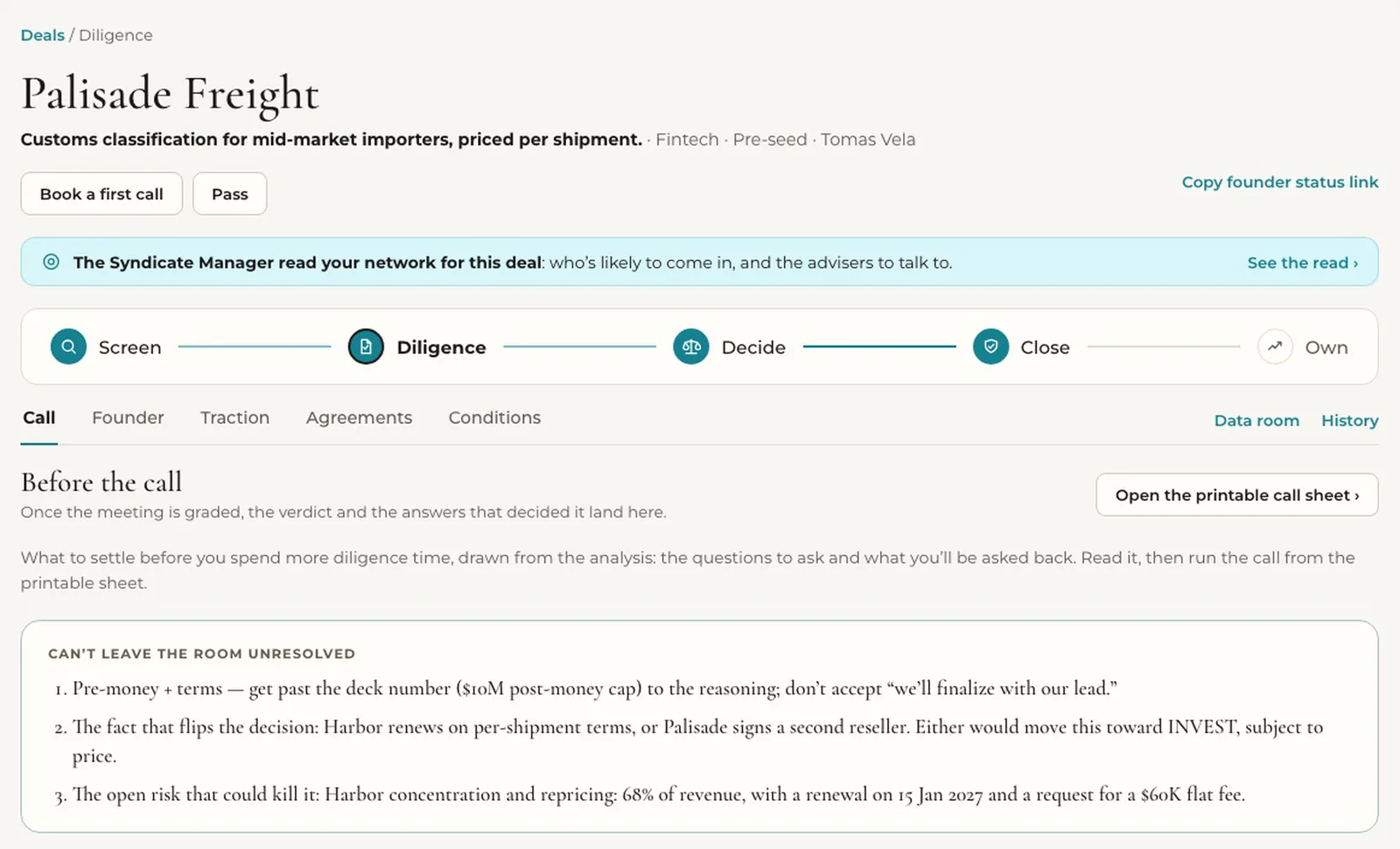
Argues against. Never sees the bull case.
Scores every call against what actually happened.
Logs every decision. Scores it later.
The bear case is the step a firm skips when it likes a deal, and the deal it likes is the one that most needs one. The Devil's Advocate writes the case against, and it is kept away from the Investment Analyst's work on purpose: an analyst asked to argue against its own read is grading its own homework.
It is allowed to fail, and that is its most valuable output. A skeptic who always finds something is a skeptic nobody weighs. Tried to kill this and could not, and here is what was tried, is the single most useful sentence available before an investment.
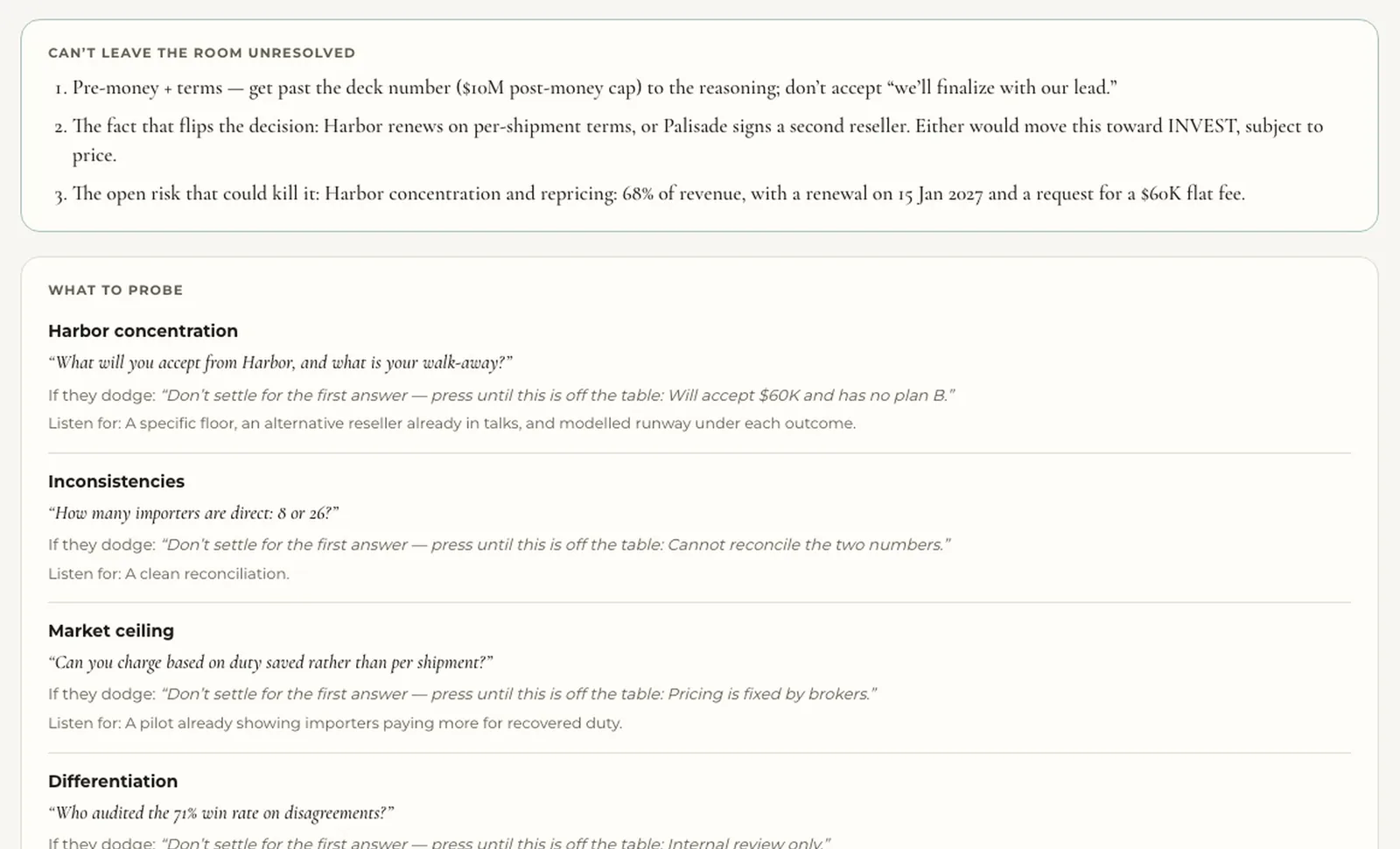
Anyone can produce a confident view. The Independent Reviewer reads each company blind to the firm and makes a call on the outcome, and the Performance Analyst measures that call against what actually happened, so the firm can see whether its machine is any good rather than assuming it.
A read can also say watch, which is the answer a great many deals deserve and most systems have no way to record.
The forecast refreshes as new reads come in, so the number you look at is the current one, and its history sits in the track record where each call is scored.
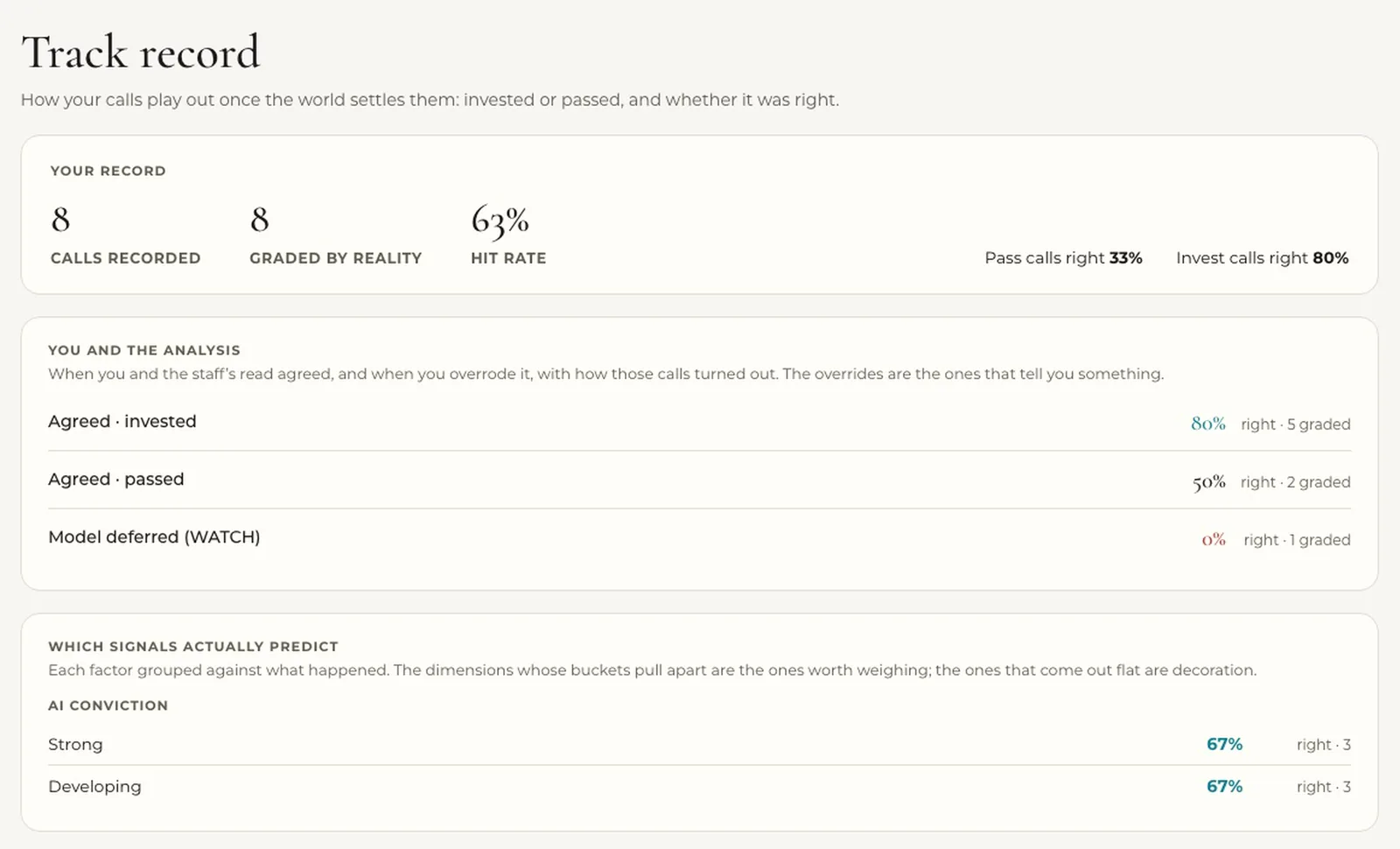
Every decision is logged as it is taken and returned to the moment there is a verdict to compare against. A firm that does not grade its own decisions repeats them, and a record reconstructed a year later is a record written from memory.
It does not wait for you to go and look. Once there are enough settled calls to mean something, it brings you the pattern worth facing, such as fewer than half your passes proving right, and it stays quiet on a healthy record.
None of this is a committee. These seats do not vote and do not decide. They argue, forecast and record, and then you make the call.
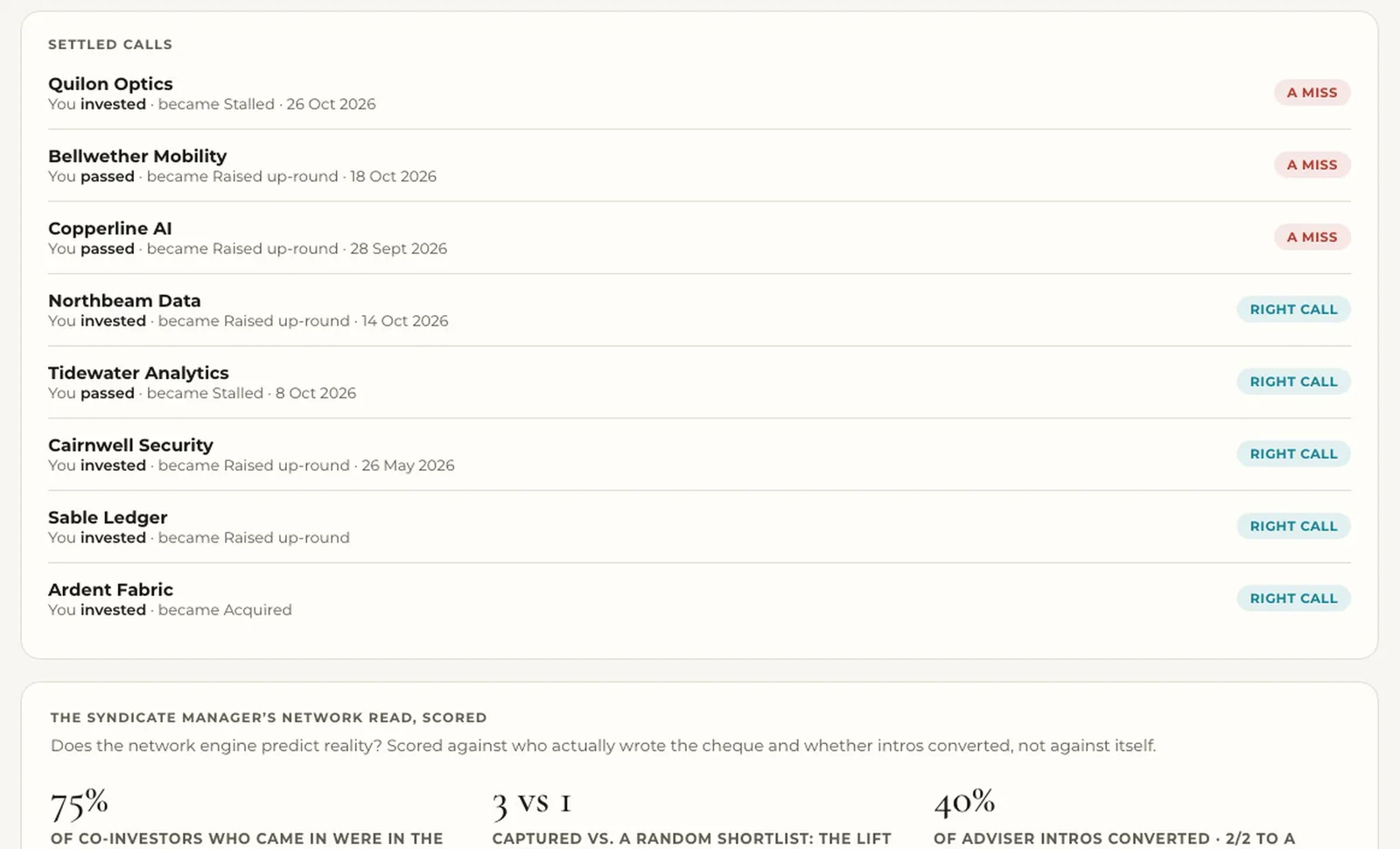
The independent reads come in during screening, so they inform the decision to advance a deal rather than arriving once it is made. When your first read is positive, the case against and the price run on their own and are in hand before you move. On a pass, nothing runs.
The deal's summary then leads with the three questions you are actually deciding: is it worth the money, do these terms make sense, and is it a fit for this firm. Each is answered by the seat whose job it is, and each answer shows its sources.
When your first read is positive, the case against and the price run on their own and are in hand before you move.
The argument arrives before you advance, not after
A committee decides. These seats do not. The Devil's Advocate argues, the Performance Analyst scores every call, the IC Secretary records, and then the general partner makes the call and owns it.
That is not modesty about what the software can do. It is the shape of the product: a firm that hands the decision to a system has swapped one kind of risk for another it cannot explain to its LPs, and no part of this is built to accept that trade.
What it does change is the quality of the argument you are having with yourself. Most solo GPs decide alone, and deciding alone means the strongest version of the objection is whichever one you happened to think of. Here it is written down before you commit, by something that never saw the case for.
The analyst's read and the case against are written apart, so the second is not the first in disguise.
When your first read is positive, the case against and the price arrive before you advance.
No seat votes. The general partner makes the call and owns it.
Every decision is logged and graded against what actually happened.
No. A committee decides; these seats do not. The Devil's Advocate argues, the Performance Analyst scores, the IC Secretary records, and the general partner makes the call.
An analyst asked to argue against its own read tends to restate it. The Devil's Advocate is kept away from the Investment Analyst's work on purpose and never sees the bull case.
Every decision is logged when it is taken and returned to once there is a verdict, so the firm can see whether its calls, and its overrides, turned out right.
The case against, scored forecasts, and a record of decisions: Devil's Advocate, Performance Analyst, IC Secretary. A firm of 21: you and twenty AI employees. See the whole firm and join the waitlist.