
Venture due diligence is the work you do between "this looks interesting" and "we're investing": checking that the team, the market, the numbers and the terms are what the pitch says they are, so you decide on evidence rather than enthusiasm.
Large funds run it with a bench: associates, analysts, counsel and a partner meeting where somebody argues against the deal. Most solo GPs, micro VCs and family offices don't have that bench, yet each position is a bigger share of a small portfolio, so a missed problem costs more.
Below is the full checklist, area by area: what to ask for, the red flags, and a shortcut for small teams. The complete checklist is at the end, ready to copy or download.
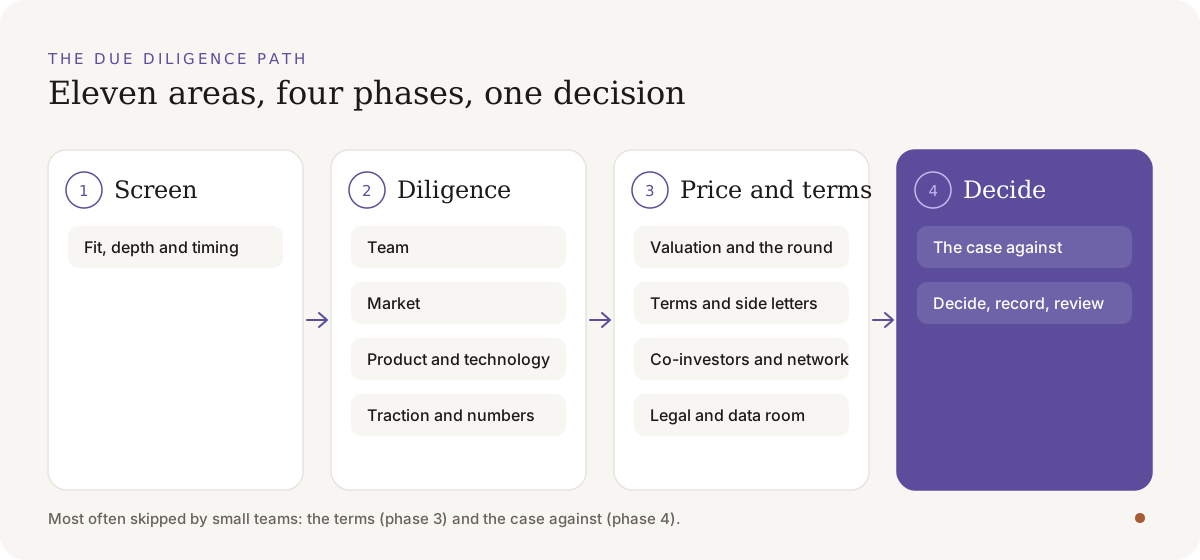
Before you start: fit, depth and timing
Before reading for quality, settle three things.
1. Does the deal fit your mandate?
Check stage, check size, sector, geography and the ownership you need. Write your mandate in one paragraph and judge every deck against it first; a quick, clear "not for us" keeps founders pitching you.
2. How deep should you go?
Scale depth to the cheque. A small cheque alongside a strong lead may need only the team, the terms and the lead's own work; a lead investment needs the full checklist.
3. How much time does the round allow?
Competitive rounds close fast. Ask early when the round closes and how much is committed, and plan to finish inside that window.
Team: can these people build this company?
At the early stage the team is most of the investment: can these founders find the answer, not do they already have it?
- Founder-market fit: why are these people unusually well placed to win this market?
- Track record: what have they built, shipped or sold before, and how did it end?
- Roles and gaps: who owns product, sales and engineering, and what is missing?
- Commitment: are founders full-time, and is their equity on a vesting schedule?
- Key-person risk: what happens if one founder leaves?
How to run reference calls
Make at least three calls, including people the founder didn't suggest: former colleagues, customers, earlier investors.
- Ask how they know the founder and for how long.
- Ask for a specific example of the founder under pressure.
- Ask what the founder is not good at, and who covers it.
- Ask whether they would work with, or back, the founder again.
Market: is it big enough, and why now?
- Size the market bottom-up: number of customers who have the problem, multiplied by what they would realistically pay.
- Ask why now: what changed (technology, regulation, behaviour) that makes this possible today and not five years ago?
- Name the real alternative: usually not another startup, but a spreadsheet, an incumbent or doing nothing.
- Check the competitive set yourself rather than relying on the deck's comparison table.
Product and technology: does it work, and who owns it?
- See the product working, ideally used by a real customer rather than in a scripted demo.
- Test the technical claims that the investment case depends on; ask an independent expert if you can't judge them yourself.
- Ask what the deck leaves out: known limitations, technical debt, things that only work at small scale.
- Confirm the company owns its intellectual property: every founder and contractor should have assigned their work to the company.
Traction and numbers: trace every figure to a source
A pitch deck is an argument, not a set of facts. Make a list of every number your investment case depends on, and mark each one verified, founder-stated or missing. Decide on the verified column; put the missing ones on the call agenda.
| Metric | Ask for | Red flag |
|---|---|---|
| Revenue | Bank statements, invoices or the accounting system, not only a dashboard | Revenue that can't be tied to cash received |
| Revenue quality | A split of recurring, one-off and pilot revenue | Pilots or one-off projects presented as recurring revenue |
| Customer concentration | Revenue by customer for the last 12 months | One customer carrying most of the revenue |
| Retention | Customer and revenue retention by cohort | Growth that hides customers quietly leaving |
| Pipeline | Named opportunities with stage and expected close | A pipeline total with no names behind it |
| Burn and runway | Monthly burn and cash in the bank | Runway shorter than the time to the next milestone |
Valuation and the round: is the price right?
- Compare the valuation with recent comparable rounds at the same stage, sector and traction, not with the founder's anchor.
- Work out your ownership after the round, and after the next one, and check it meets your fund's target.
- Understand the round: who is leading, how much is committed, and how much is still open.
- For convertible instruments, be clear whether the valuation cap is pre-money or post-money; the difference changes your ownership.
Terms: read every document before you sign
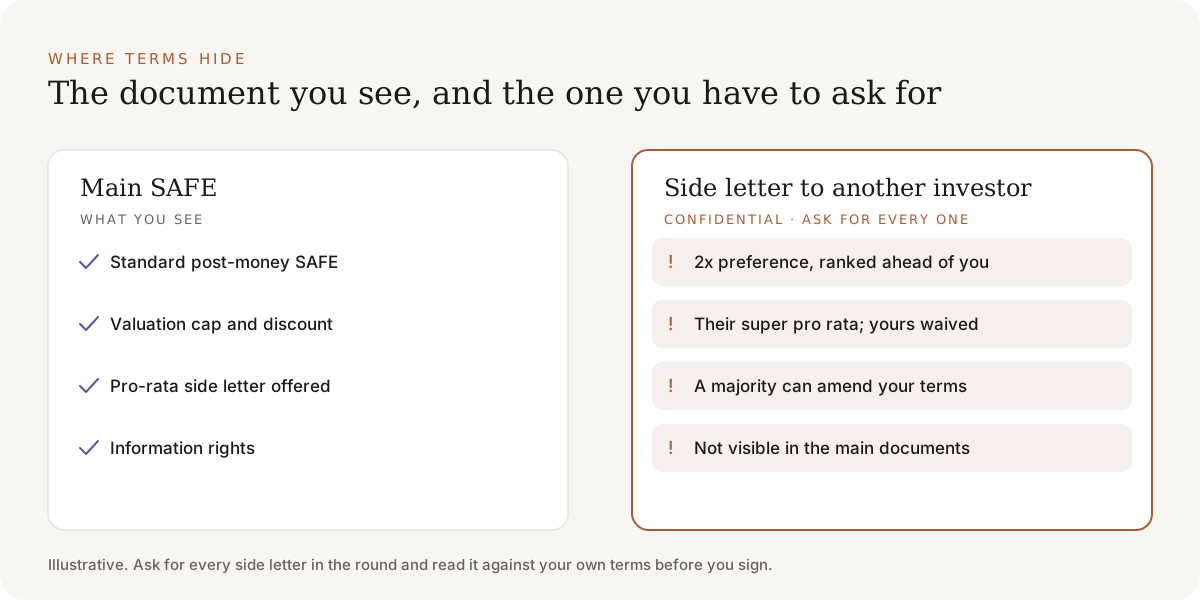
Unusual terms hide in side letters, convertible-note and SAFE provisions, and amendment clauses. They can change the return profile of a deal that looked straightforward. Keep a standard list and read every document in the close against it.
| Term | What to check | Ask counsel about |
|---|---|---|
| Liquidation preference | The multiple and whether it is participating | Anything above 1x, or participating preferences, especially if granted to another investor |
| Pro-rata rights | Whether you can keep your ownership in later rounds | Your pro rata being waived while another investor gets enhanced rights |
| Most-favoured-nation (MFN) | Whether you receive better terms given to later investors | MFN clauses that exclude you, or exclude side letters |
| Side letters | Every side letter given to any investor in the round | Rights that rank ahead of yours or aren't disclosed in the main documents |
| Amendment clauses | Who can change the terms after signing | A majority of holders being able to amend your terms without your consent |
| Information rights | What reporting you will receive, and how often | No information rights at all for a meaningful position |
This guide is not legal advice. Use it to know which questions to ask, and escalate anything unusual to your counsel before the money moves, not after.
Co-investors and the network: who comes in with you
In early-stage venture, who is in the round can matter as much as the company. A strong lead does work you benefit from; the right co-investors help fill the round and help the company later; the right operators and advisers can solve the risks your diligence found.
- Who is leading, and what diligence have they done? Ask for their memo or their key questions.
- Who else is committed, at what size, and on what terms?
- Which co-investors in your own network fit this deal and have not been asked yet?
- For each major risk you found, who in your network could help: an operator, an adviser, a potential customer?
- Has anyone in your network passed on this company, and why?
Legal and data room: what must be in place before close
- Company formation documents and the current capitalisation table, including options and convertibles
- Intellectual-property assignments from founders, employees and contractors
- Material customer and supplier contracts, especially the largest customers
- Any litigation, disputes or regulatory issues
- Employment agreements for key people
- Licences, permits or compliance requirements specific to the sector
Send the founder a written list of data-room gaps early, not on the close date.
The case against: run a pre-mortem before you decide
This is the step small teams skip most often, and the one large funds protect most. In a partnership someone's job is to look for the crack. Alone, you have to do it deliberately.
- Imagine it is three years from now and the investment has failed.
- Write the most likely reasons, one paragraph each: the market, the team, the numbers, the terms.
- For each reason, note what evidence you already have for or against it.
- Decide which risks you are accepting and which would change your mind.
Decide, record and review
A record of every decision becomes your track record: the evidence LPs, or the family, will ask for.
For every invest or pass, write a short memo:
- The decision, and the one-paragraph thesis
- The main risks you accepted
- What would change your mind
- The co-investors and terms
Every six months, score past decisions, including passes, against what actually happened. The calls you got wrong teach you more than the ones you got right.
Due diligence for family offices investing directly
Family offices investing directly in startups, often alongside venture funds, use the same checklist with three differences in emphasis.
Governance
You answer to a family, not to LPs. Document why each investment was made, what was checked and who approved it, so the decision can be reviewed later by family members who weren't in the room.
Co-investing alongside funds
When a fund leads, read its diligence but don't rely on it alone: its incentives, timing and portfolio needs may differ from yours. Check your terms against the lead's, including side letters.
Concentration and liquidity
Direct startup positions are illiquid for many years. Decide in advance how much of the family's capital belongs in this asset class, and how follow-on investments will be funded.
The complete VC due diligence checklist
Copy this into your deal notes and work through it for every serious deal. The two marked are the steps small teams skip most often.
Download the checklist (CSV for Excel, Sheets or Numbers)Fit and timing
- Mandate fit: stage, check, sector, geography, ownership
- Depth decided for the size of the cheque
- Close date and committed amount known
Team
- Founder-market fit and track record assessed
- Vesting and key-person risk checked
- Three or more reference calls, including off-list
Market and product
- Bottom-up market size and why now
- Real alternative and competitors named
- Core technical claims tested; IP assigned to the company
Numbers
- Every key number marked verified, founder-stated or missing
- Revenue quality, concentration and retention checked
- Burn and runway against the next milestone
Valuation and terms
- Valuation compared with comparable rounds
- Ownership after this round and the next
- Every document and side letter read against your terms listoften skipped
Round, legal and decision
- Lead, co-investors and allocations understood
- Data-room gaps listed before close
- A written case against the dealoften skipped
- Decision memo recorded; review date set
How to run this checklist without a team
None of these steps needs a large team. They need owners. Small funds skip steps not for lack of skill, but because one or two people can't be the screener, the analyst, the skeptic and the IC secretary in the same week.
That's the gap DealflowHQ was built for: an AI deal team for solo GPs, micro VCs and family offices. Twenty AI specialists each own a part of this checklist, working overnight, and the general partner, or the family's decision-maker, makes every call. Nothing is sent or signed without approval.
| Checklist step | Who does the work |
|---|---|
| Fit | Screening Associate: reads each deal against your mandate |
| Pipeline | Deal Flow Manager: flags every deal left waiting |
| Numbers | Diligence Associate: traces every number to a source |
| Valuation | Valuation Analyst: prices the round against the market |
| References | Reference Checker: maps references and preps your calls |
| Terms | General Counsel: reads the terms before you sign and flags what's unusual |
| Co-investors | Syndicate Manager: reads your network for who is likely to come in |
| Case against | Devil's Advocate: argues against, and never sees the bull case |
| Record | IC Secretary: logs every decision and scores it later |
How DealflowHQ runs diligence · the deal memo and the case against · see the whole firm
Frequently asked questions
What is VC due diligence?
Venture capital due diligence is the investigation an investor carries out before investing in a startup: verifying the team, market, product, numbers, legal position and terms, so the decision rests on evidence rather than the pitch.
What should a VC due diligence checklist include?
At minimum: mandate fit, the team and references, market size and timing, product and IP ownership, verified traction and financials, valuation and ownership, the investment terms and side letters, co-investors, the data room, a written case against the deal, and a recorded decision.
How long does VC due diligence take?
It depends on the cheque size and the round. Competitive early-stage rounds can require a decision in days; larger or lead investments usually take longer. Scale the depth to the size of the investment, but don't skip the terms or the case against.
What are common red flags in startup due diligence?
Founders without vesting, revenue that can't be tied to cash, heavy dependence on one customer, a market size that only exists top-down, intellectual property not assigned to the company, and terms in side letters that rank other investors ahead of you.
How do family offices do due diligence on direct investments?
They use the same checklist as a venture fund, with more emphasis on governance (documenting why each decision was made), on checking their own terms when co-investing alongside a fund, and on how direct positions fit the family's liquidity and allocation plans.