
Seven seats do the reading a deal needs before a partnership argues about it. The money figures are taken back to their source, and one that cannot be placed is named rather than smoothed over.
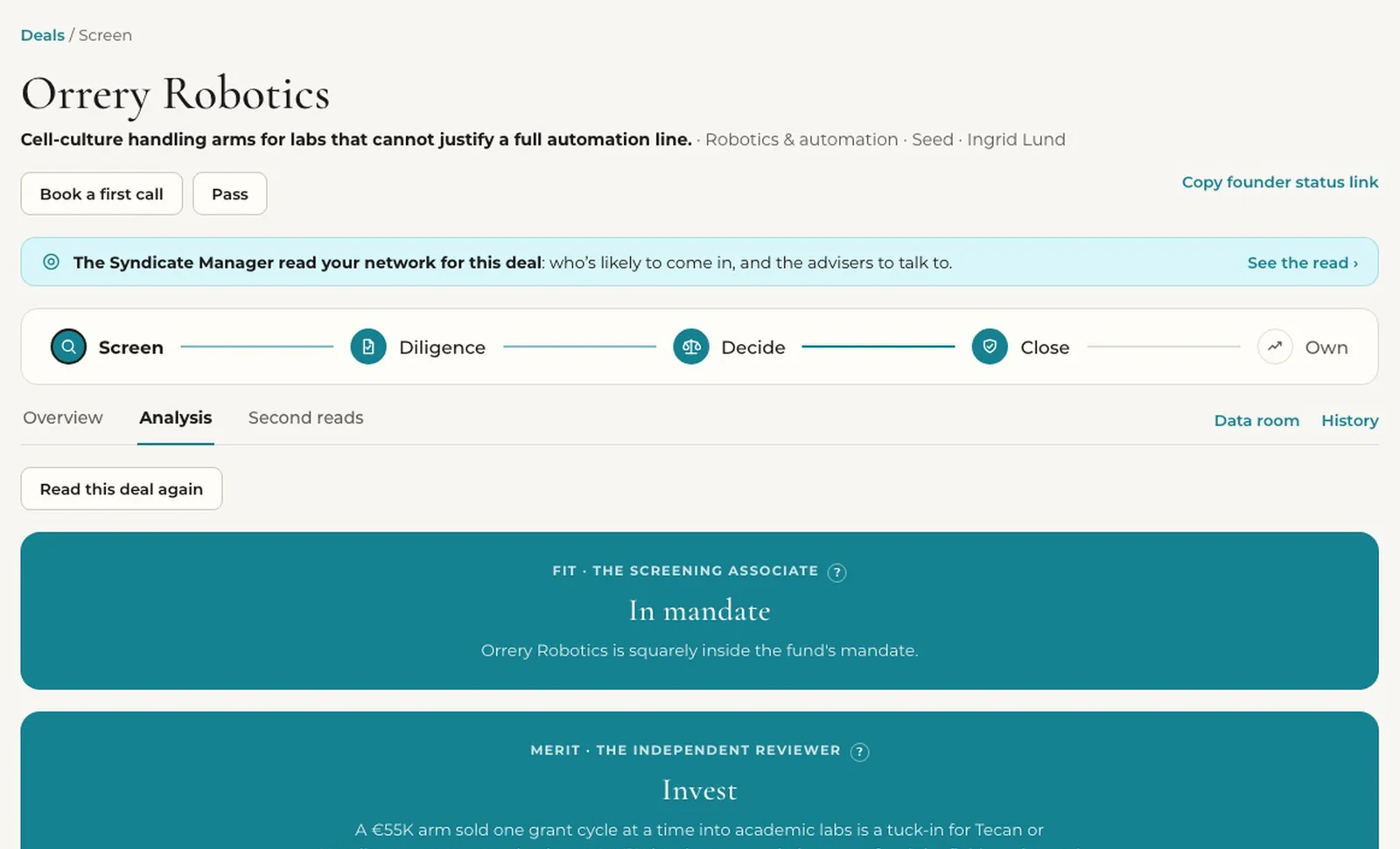
Reads a deal against your mandate — stage, check, sector, geography. Fit, not merit.
Tells you when new evidence undercuts your read.
Finds what the deck left out.
Traces every number to a source.
Prices the round against the market.
Watches the market while a deal is still open. Flags what bears on your read.
Maps references on the founders. Preps the calls you make.
The Screening Associate reads every deal against your mandate: stage, cheque size, sector and geography. It answers whether the deal is one this firm does, not whether it is a good company, and it keeps those two questions apart on purpose.
The Market Analyst watches the market while a deal is still open, and flags what bears on your read, so a change around the company reaches you before you decide rather than after.
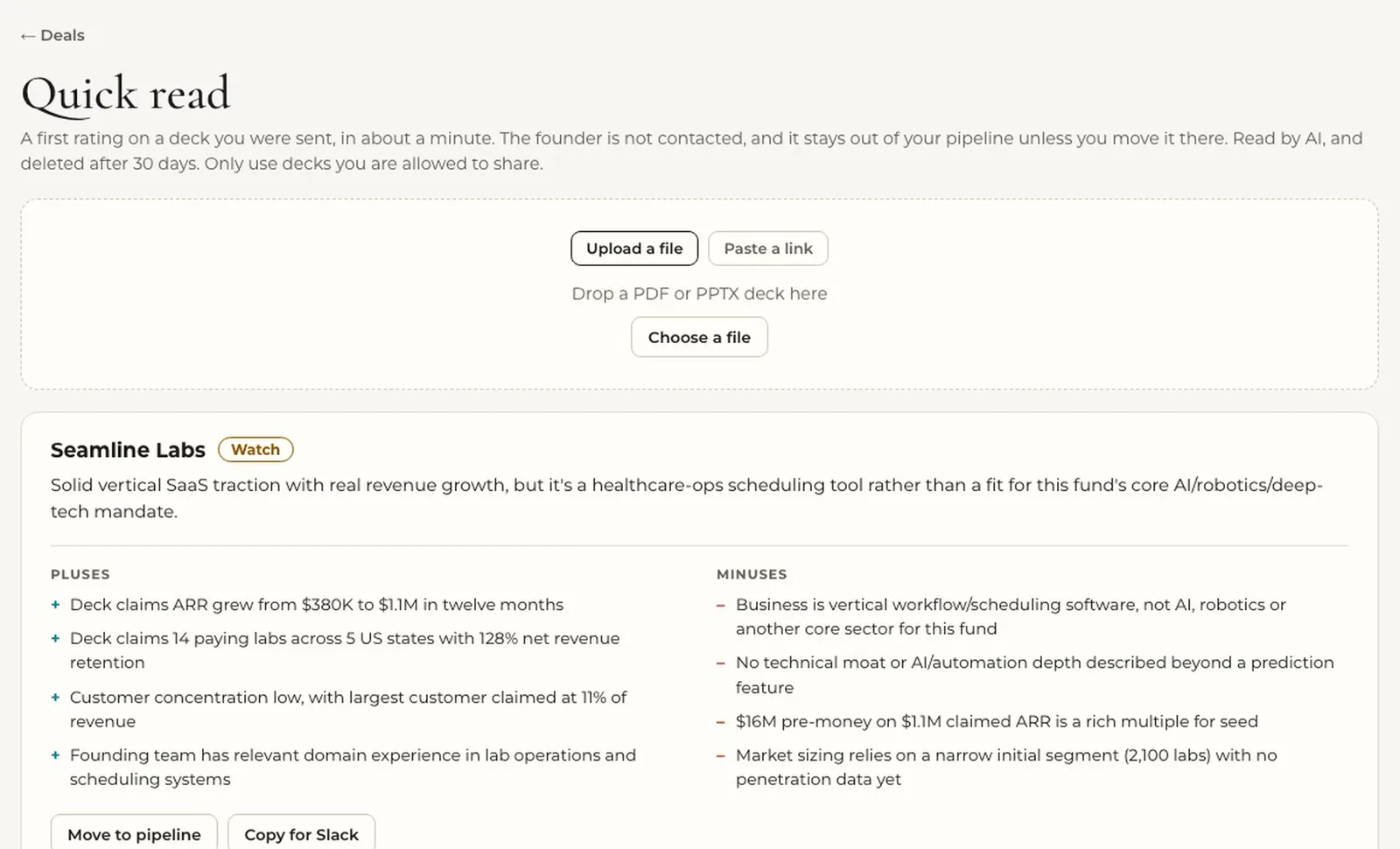
The Investment Analyst writes the read and tells you when new evidence undercuts it. That second half is the part most tools skip: a memo written once and never revisited is a snapshot somebody acts on months later.
The Technical Advisor works the other direction and finds what the deck left out. A pitch is an argument, and the things it does not mention are usually the things worth an hour.
A pitch is an argument, and the things it does not mention are usually the things worth an hour.
An AI deal memo, not a yes-machine
The Diligence Associate takes the money figures in the read back to the material they came from. A number lifted from the deck, one derived by arithmetic it can redo, and one that appears nowhere are three different findings, and it reports them as three different findings.
It never calls a figure false. It names the figure, says where it looked, and asks. There are innocent reasons a number is hard to place, and a checker that accuses is a checker a partner learns to ignore.
It never calls a figure false. It names the figure, says where it looked, and asks.
Money figures taken back to their source
When a deal rests on a claim a government keeps a record of, the staff looks it up. A US round is checked against its Form D on SEC EDGAR. A Japanese company's grants and public contracts, listed partners and patents are checked against gBizINFO, EDINET and J-PlatPat, by its corporate number and in Japanese.
Each finding cites the record it came from. A claim with nothing on file comes back as not found rather than disputed, and a filing is never read as more than it says: a Form D gives an amount and a date, not a valuation or a list of investors.
A claim with nothing on file comes back as not found rather than disputed
Checked against the public record
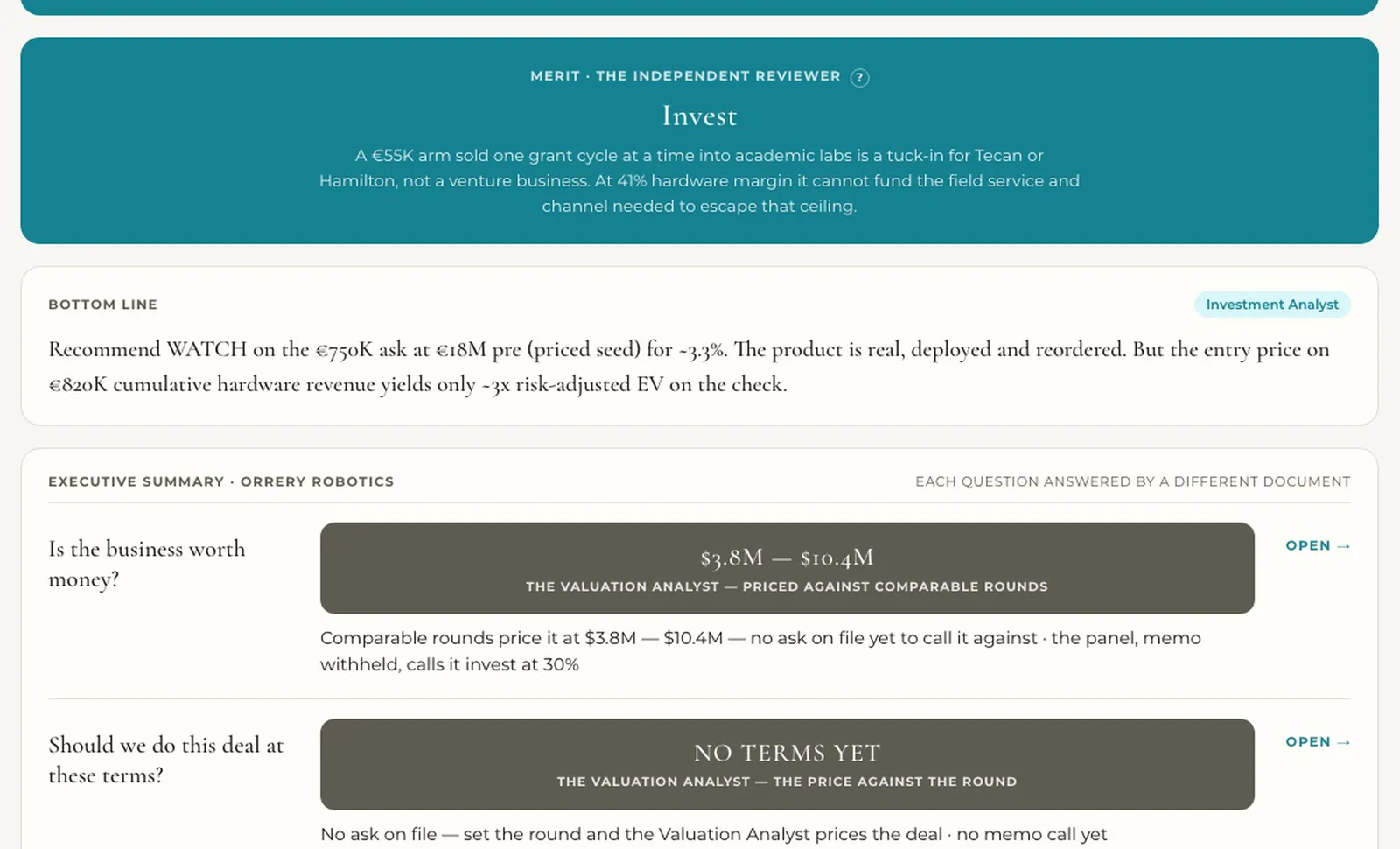
The Valuation Analyst prices the round three ways and shows all three side by side, each before the money goes in so they actually compare: what similar rounds are paying, what the Valuation Analyst calculates the company is worth, and what the founder is asking. Behind its own figure sit the formal methods, each with its own number, shown as cross-checks rather than blended into one.
So whether the business is worth the money, and whether the terms make sense, is answered before the meeting rather than in it. The round is priced in the currency it was raised in, which matters the moment a company is based outside the US.
The Reference Checker maps references on the founders and prepares the calls you make. It does not make them. Reference calls are a partner's job and the value is in what a founder's former colleague will say to a person they can read.
They do not decide. No seat invests, passes or holds a deal. They read, check, price and prepare, and then a partner reads their work and makes a call.
They do not contact anybody. The Reference Checker prepares a reference call it will never make, and no seat emails a founder, an investor or a customer of the company being diligenced.
And the Diligence Associate will not call a figure false, which is the constraint that makes the rest of it usable. Two attempts to check provenance by rule failed here by flagging thousands of figures that were perfectly sound, and an accusation that is wrong often enough is ignored entirely. Saying plainly that a number cannot be accounted for, and naming where it looked, is the version a partner actually reads.
From your inbox, a founder's application or a link you paste. Nothing is sent to anybody.
Fit against your mandate, then the analyst's read, the numbers traced, the round priced, the public record checked.
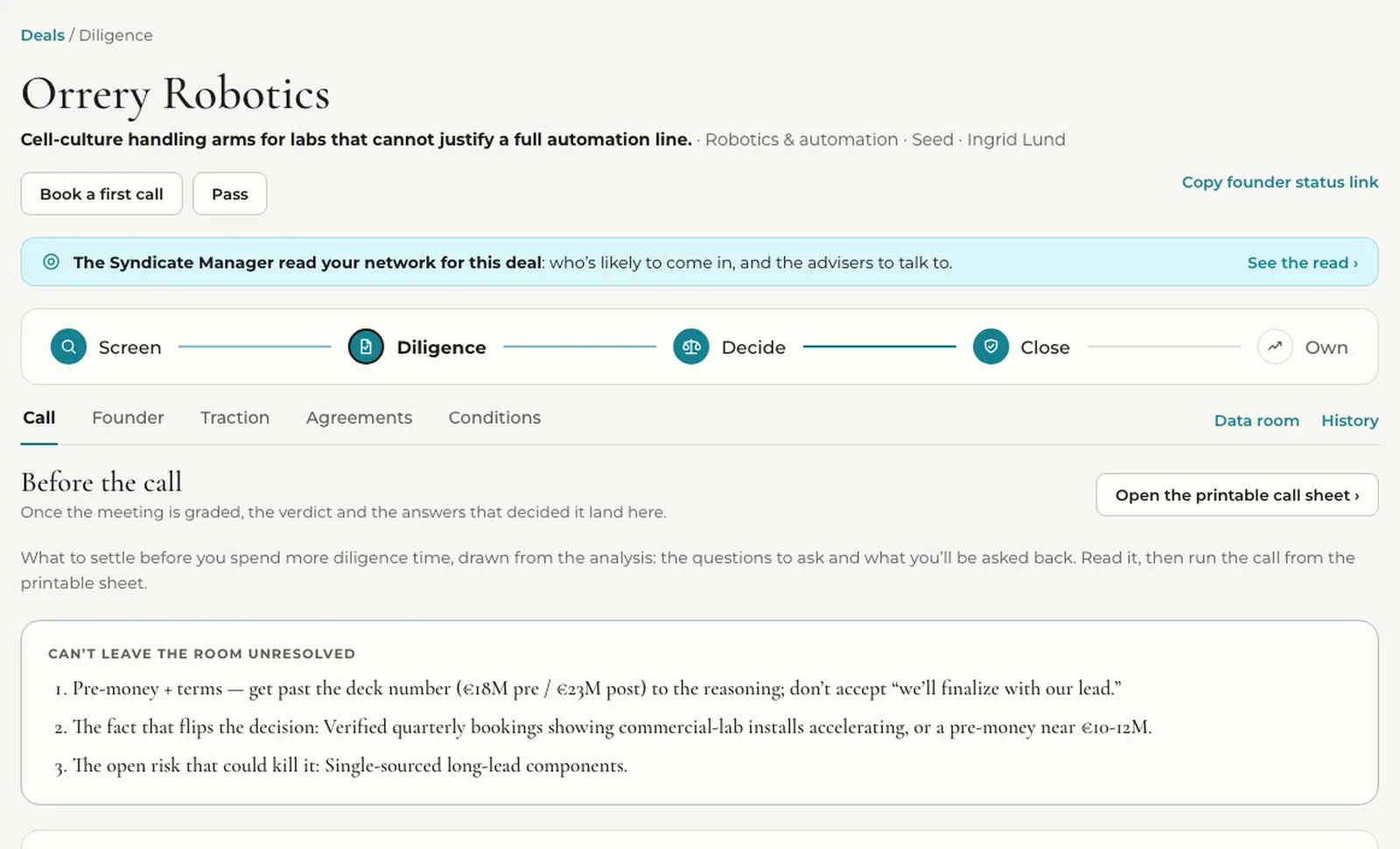
The questions to settle on the call, the references worth calling, and what the deck left out.
No seat invests or passes. You read the work, make the call, and it is recorded with its reason.
No. The diligence seats read, check, price and prepare. A partner reads their work and makes every call; no seat invests, passes or holds a deal.
No. The Reference Checker prepares the reference calls you make, and no seat emails a founder, an investor or a customer of the company.
The Diligence Associate traces each money figure to its source and reports one it cannot place as unaccounted for, naming where it looked. It never calls a figure false.
Diligence: the Screening Associate, Investment Analyst, Technical Advisor, Diligence Associate, Valuation Analyst, Market Analyst and Reference Checker. A firm of 21: you and twenty AI employees. See the whole firm and join the waitlist.