
Raising is a second job that arrives in fragments: an allocation that never hardened, an investor who went quiet, a letter somebody owes a founder. Two seats hold the thread so none of it is dropped.
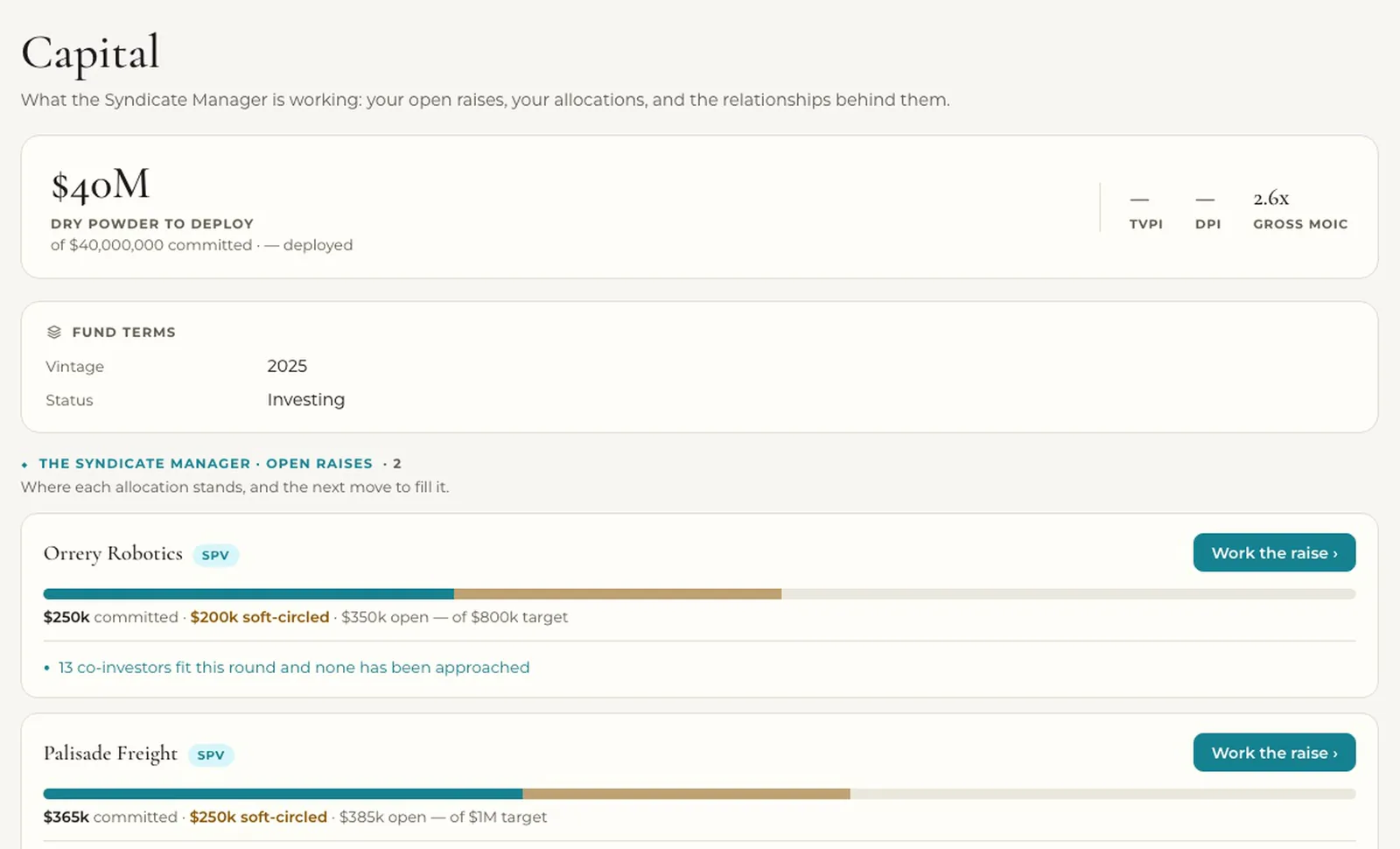
Tracks soft commits and stalled allocations. Keeps LPs from going cold.
Drafts the letters a deal owes people. You send.
Translates the deal and reads the room. On demand, per deal.
Interest that was promised and never hardened, allocations that have stalled, and LPs who have gone quiet since the last close are the three ways a round slips without anybody noticing on a given day.
The Syndicate Manager tracks all three on real dates, so the conversation you need to have this week is the one it puts in front of you.
It also notices interest warming up. When someone you shared a deck with keeps reopening it, and the deck belongs to a live deal, it tells you while a call still means something. A note for you, not a move it makes on your behalf.
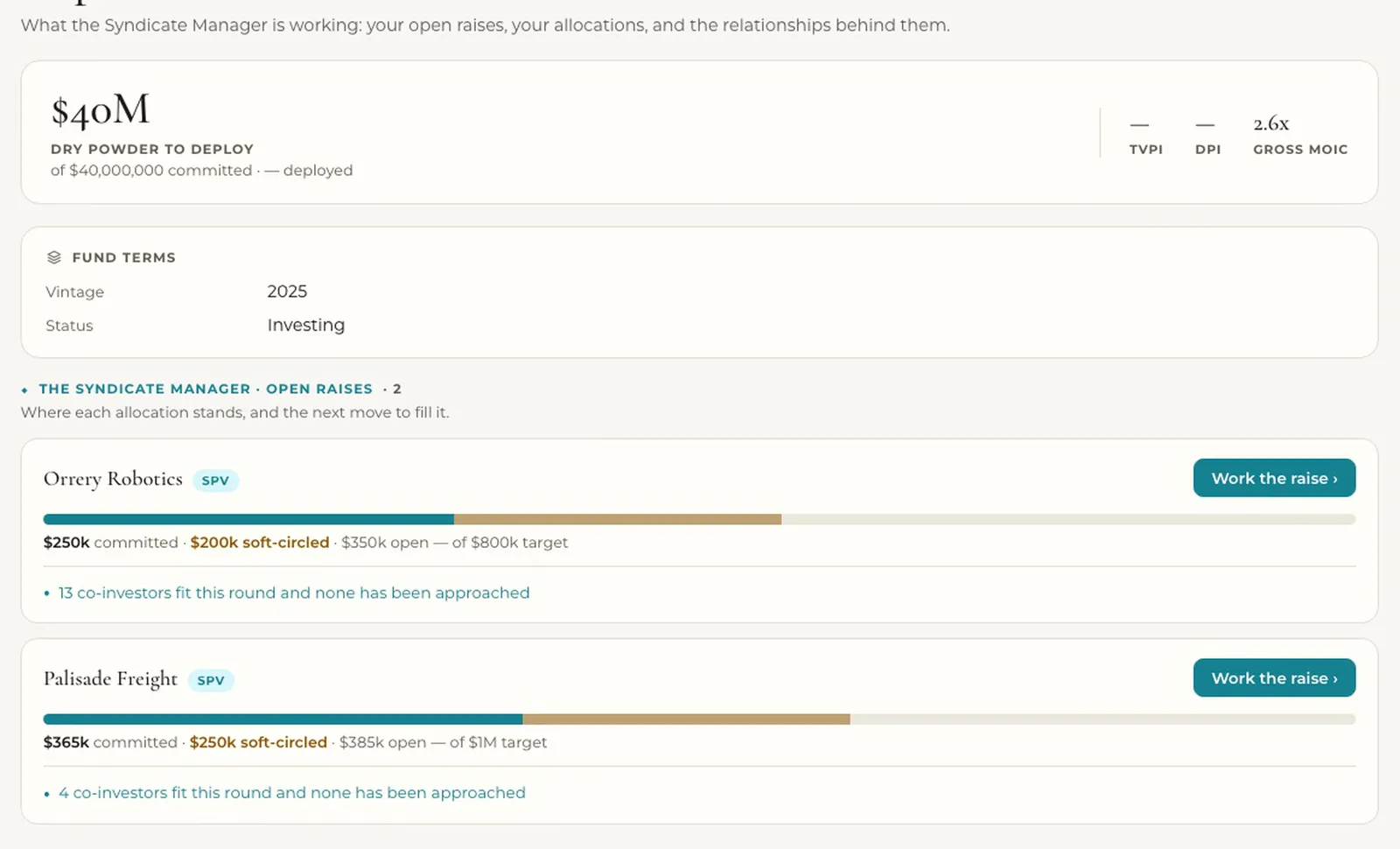
Your relationships are read deal by deal: who to syndicate a round with, which of your contacts opens a warm path to the company, and where an introduction is worth making. The people half of a deal sits beside the analysis instead of in your memory.
When a deal needs a language and a context the rest of the staff does not carry, the Japan Desk translates it and reads the room around it, on demand and one deal at a time.
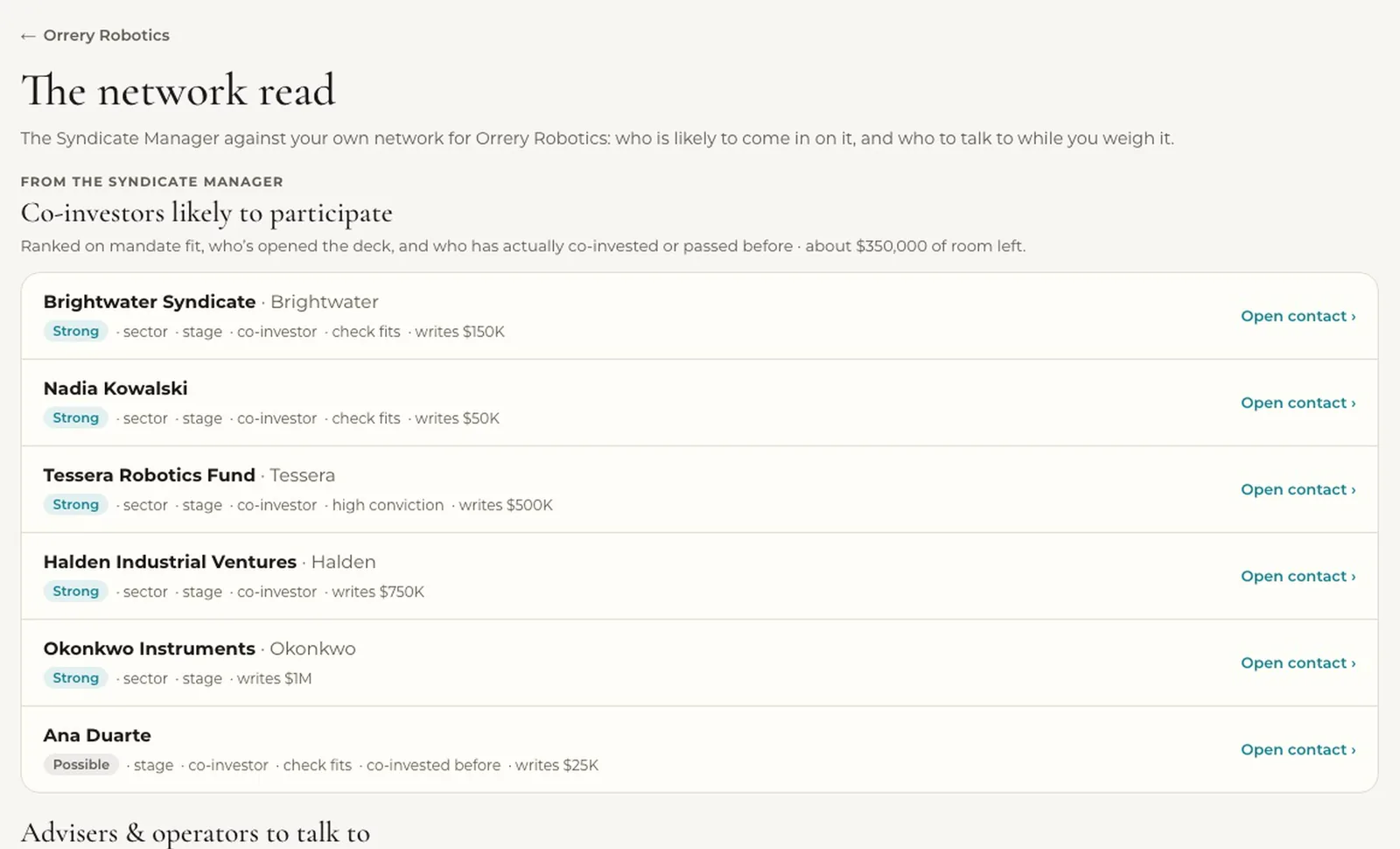
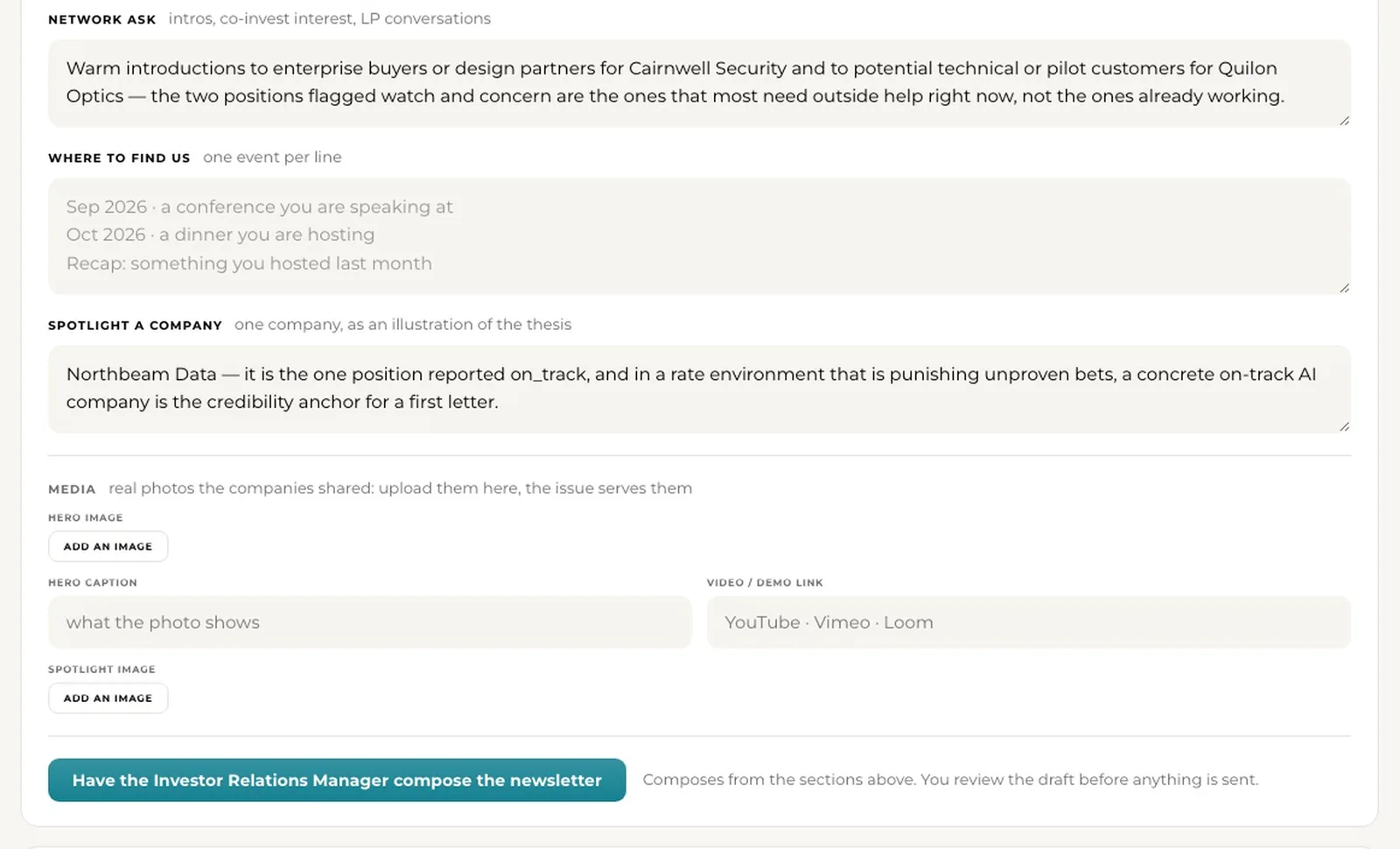
A deal owes people letters: the founder you passed on, the investor who asked for an update, the introduction you promised at a conference. The Investor Relations Manager drafts them.
Nothing leaves without you. That is not a setting, it is how the product is built: the seats produce work and a partner presses send. A system that emails your LPs on its own is a different risk profile than any fund should accept.
Capital work is not hard, it is relentless. Somebody has to remember that an investor asked for an update six weeks ago, that an allocation was verbally agreed and never papered, and that a founder was promised an introduction at a conference in March.
None of that is urgent on any given day, which is precisely why it slips. A fund does not lose an LP in a meeting; it loses one over a year of not being in touch.
A fund does not lose an LP in a meeting; it loses one over a year of not being in touch.
The work that slips when a fund is one person
Every letter these seats produce arrives as a draft on your desk. You read it, change it, and send it, or you do not send it.
That is a deliberate limit rather than a missing feature. The relationships a fund has with its investors and its founders are the fund, and a system that writes to them on its own initiative is spending an asset it does not own.
It is also what makes the work usable at all: a partner can put their name to a letter they read, and cannot put their name to one that went out overnight.
Who is likely to co-invest, how much they write, and the warm way in to the company.
Soft commits that never hardened and allocations that stalled, on real dates.
Updates, introductions and LP letters, composed from the real numbers.
Nothing leaves without you. Every letter arrives as a draft.
Your relationships are read deal by deal: who to syndicate a round with, which contacts open a warm path to the company, and where an introduction is worth making.
No. The Investor Relations Manager drafts; you read, change and send, or don't. That is how the product is built, not a setting.
An on-demand seat that translates a deal and reads the room for firms investing in or from Japan.
Capital and LP work: the Syndicate Manager, the Investor Relations Manager and the Japan Desk. A firm of 21: you and twenty AI employees. See the whole firm and join the waitlist.